.png)
Curriculum Overview
COURSE OF STUDY 2026-2027
- Math (Algebra I, Honors Algebra I, Honors Geometry, Honors Algebra II)
- Literature (Literature I, Honors Literature I)
- Science (Biology, Honors Biology)
- History (World History)
- Religion (Religion I)
- World Language or American Sign Language (Spanish I, Honors Spanish I, Spanish II, Honors Spanish II, ASL I, or online World Language)
- Leadership I
- Math (Geometry, Honors Geometry, Algebra II, Honors Algebra II, Honors Precalculus)
- Literature (Literature II, Honors Literature II)
- Science (Chemistry, Honors Chemistry)
- History (US History I, Honors US History I, AP US History I)
- Religion (Religion II)
- World Language (Spanish II, Honors Spanish II, Spanish III, Honors Spanish III, ASL I or II, or online World Language)
- Leadership II (One Semester) / Intro to Art, Intro to Music, Intro to Allied Health (One Semester)
- Math (Algebra II, Honors Algebra II, Precalculus, Honors Precalculus, AP Calculus AB)
- Literature (Literature III, Honors Literature III, AP Language and Composition)
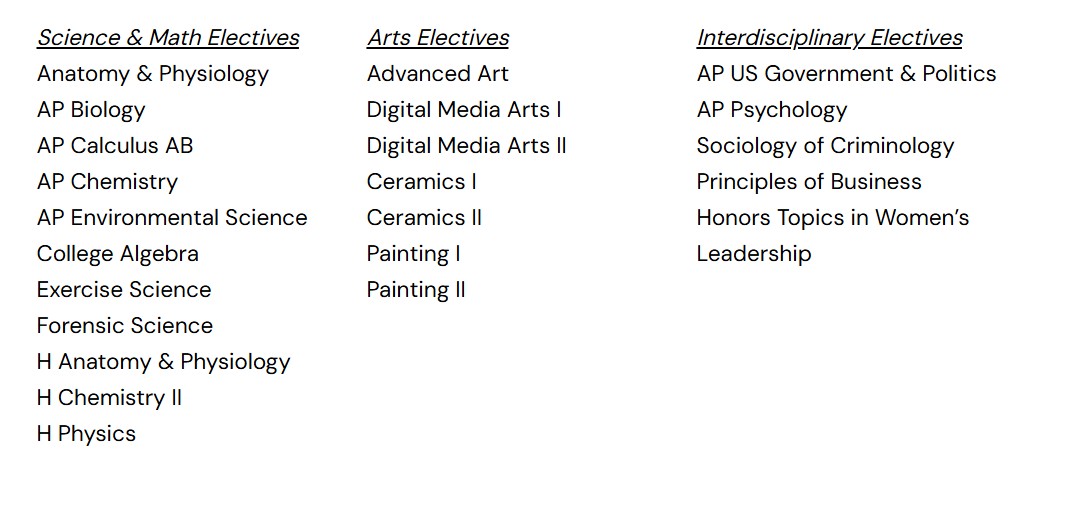
- Science (Anatomy and Physiology, Honors Anatomy and Physiology, Chemistry II, Honors Chemistry II, AP Chemistry, Exercise Science, Forensic Science, AP Environmental Science)
- History (US History II, Honors US History II, AP US History II)
- Religion (Religion III)
- Two Electives (3rd year of a World Language recommended)
- Math (Precalculus, Honors Precalculus, College Algebra, AP Calculus AB, AP Statistics, Approved RCSJ Math Course)
- Literature (Literature IV, Honors Literature IV, AP Literature and Composition)
- Religion (Religion IV)
- Four Electives
Course Descriptions
Literature I
Literature I is a college preparatory course that introduces students to foundational skills in language acquisition, writing, literary analysis, and evidence-based composition. Through the study of nonfiction, novels, short stories, and poetry, students will develop an understanding of an author’s purpose and the ways in which writers use language and literary elements to create meaning. Students will explore a variety of literary genres while developing their reading, writing, and analytical skills. The selection of texts will provide students with insight into literary elements as well as the diverse experiences and perspectives that contribute to the human experience. Prerequisite: None
Honors Literature I
Honors Literature I is an advanced English course designed to challenge students to think critically, read deeply, and write effectively. Students will explore foundational skills in literary analysis, composition, and reading comprehension across a variety of genres, including novels, short stories, poetry, drama, and nonfiction. Through close reading and discussion, students will examine how authors convey themes, develop complex characters, and employ literary and rhetorical techniques to shape meaning. The course emphasizes independent thinking, analytical writing, and active participation. Students are expected to engage thoughtfully in discussions, activities, group reading, and multi-draft essays that demonstrate depth of thought and mastery of honors-level skills. Prerequisite: Entrance exam qualification and 8th grade transcripts
Literature II
Literature II is a college preparatory course designed to strengthen students’ analytical reading, writing, and critical thinking skills. Students will engage with a diverse selection of literary works and informational texts while continuing to develop their vocabulary, composition, and grammar skills. Through close reading, discussion, and research, students will explore timeless themes, evaluate authorial choices, and strengthen their ability to interpret, analyze, and present arguments effectively. Literary devices will be introduced and reviewed throughout the course and applied across a variety of readings and genres. Prerequisite: Literature I
Honors Literature II
Honors Literature II provides a challenging curriculum designed to deepen students’ understanding of literature, vocabulary, composition, and authorial choices. The course emphasizes critical analysis and encourages students to develop original interpretations of literary works. In addition to literary analysis, students will conduct research related to works of literature, their historical time periods, and their authors. Students will continue to refine their writing skills while developing a deeper understanding of the complexities and intricacies of literature. Prerequisite: B in Honors Literature I or A in Literature I
Literature III
Literature III is a college preparatory course in which students explore the works of major American authors who witnessed and contributed to the growth of the American nation. Students will analyze a variety of genres within American literature while developing a functional understanding of major trends in American history and philosophy and examining how literary works reflect their respective time periods. The writing component of the course builds upon previously developed skills, with an emphasis on writing in a clear, concise, organized, and convincing manner. Students will also continue to strengthen their understanding and application of grammar, punctuation, and vocabulary while preparing for the SAT. Prerequisite: Literature II
Honors Literature III
Honors Literature III is an advanced course in which students explore the works of major American authors who witnessed and contributed to the growth of the American nation. Students will analyze a variety of genres within American literature while developing a functional understanding of major trends in American history and philosophy and examining how literary works reflect their respective time periods. Honors students are expected to engage with literature at a faster pace and in greater depth than students enrolled in the college preparatory course. The writing component builds upon previously developed skills, with an emphasis on writing in a clear, concise, organized, and convincing manner. Students will also continue to strengthen their understanding and application of grammar, punctuation, and vocabulary while preparing for the SAT. Prerequisite: B in Honors Literature II or A in Literature II
AP Language and Composition
AP English Language and Composition is a college-level course that cultivates the critical reading, analytical thinking, and effective writing skills necessary for college success and thoughtful participation in civic life. Students will become curious, critical, and responsive readers of diverse texts while developing the flexibility and reflection necessary to write effectively for different audiences and purposes. The central focus of the course is rhetoric and the ways in which language functions in specific situations to communicate a writer’s purpose, shape an audience’s response, and contribute to larger conversations. Students will study narrative, expository, analytical, argumentative, and creative writing, with particular emphasis on nonfiction texts and rhetorical contexts. While American literature plays an important role in the course, students will also engage with essays, speeches, letters, memoirs, journalism, visual texts, political writing, historical documents, and works representing a variety of periods, disciplines, and perspectives. Throughout the course, students will examine the dynamic relationship between writer, audience, purpose, context, and argument. Students will analyze how writers use structure, style, evidence, diction, syntax, tone, and rhetorical appeals to develop ideas and influence readers. The course also includes the analysis of non-print and visual texts, including images, comics, charts, graphs, and other forms of communication, while helping students develop greater independence and care when reading footnotes, citations, and source material. Writing is a major component of the course. Students will write frequently in a variety of modes, including rhetorical analysis, argument, synthesis, personal reflection, research-based writing, and creative or exploratory pieces. Emphasis is placed on organization, evidence, reasoning, vocabulary, sentence control, research skills, and command of language. Students will apply standard English grammar with increasing precision, maturity, and sophistication. As an Advanced Placement course, AP English Language and Composition moves at a faster pace, addresses reading and writing skills in greater depth, and maintains higher expectations for student performance than an honors-level course. With its sustained focus on nonfiction, argument, and the persuasive power of language, the course encourages students to consider not only what texts say, but also how they work, why they matter, and how language can clarify, challenge, persuade, and shape public thought. The course is designed to prepare students for the Advanced Placement English Language and Composition Exam while helping them become more confident writers, discerning readers, and responsible participants in the conversations that shape the world around them. Prerequisite: B in Honors Literature II or A in Literature II
Literature IV
Literature IV is a college preparatory course that introduces students to classic and contemporary works by women writers. Students will explore a variety of literary genres, including novels, plays, short stories, memoirs, and poetry, while gaining a deeper appreciation for themes, styles, and literary techniques employed by women writers. Students will read extensively both inside and outside the classroom and engage in analytical interpretation and meaningful class discussion. The writing component of the course builds upon previously developed skills and provides students with opportunities to write for a variety of purposes, including literary analysis and reader response. Vocabulary development is an ongoing component of the course and is integrated with students’ reading and writing experiences. Prerequisite: Literature III
Honors Literature IV
Honors Literature IV is an advanced course that introduces students to classic and contemporary works by women writers. Students will explore a variety of literary genres, including novels, plays, short stories, memoirs, and poetry, while gaining a deeper appreciation for the themes, styles, and literary techniques employed by women writers. Students will read extensively both inside and outside the classroom and engage in analytical interpretation and meaningful class discussion. Honors students are expected to engage with literature at a faster pace and in greater depth than students enrolled in the college preparatory course. The writing component builds upon previously developed skills and provides students with opportunities to write for a variety of purposes, including literary analysis and reader response. Vocabulary development is an ongoing component of the course and is integrated with students’ reading and writing experiences. Prerequisite: B in Honors Literature III or A in Literature III or C in AP Language & Composition
AP Literature and Composition
AP English Literature and Composition is a college-level course that focuses on the close reading, critical analysis, and thoughtful interpretation of imaginative literature, including fiction, poetry, and drama from a variety of periods and traditions. Students will engage in the careful study of literary works of recognized merit while developing a deeper understanding of how writers use language, structure, style, and literary techniques to create meaning and artistic effect. Throughout the course, students will examine themes, form, characterization, imagery, figurative language, symbolism, and narrative or dramatic structure. Through close reading and analysis, students will consider not only what a text says, but also how and why it produces meaning. In doing so, students will sharpen their awareness of language and strengthen their appreciation for the writer’s craft. Writing is a central component of the course. Students will compose expository, analytical, and argumentative essays that require them to develop clear interpretations of literary works and support those interpretations with precise textual evidence. Students may also complete creative writing assignments, including stories, poems, scenes, or other imaginative pieces, to deepen their understanding of literary techniques from the writer’s perspective. The goal of writing throughout the course is to help students explain clearly, cogently, and, when possible, elegantly what they understand about literature and why they interpret it as they do. Students should expect to read extensively both inside and outside the classroom, including the completion of a required summer reading assignment. As an Advanced Placement course, AP English Literature and Composition moves at a faster pace, addresses literary concepts in greater depth, and maintains higher expectations for student performance than an honors-level course. The course is designed to prepare students for the Advanced Placement English Literature and Composition Exam while helping students become more perceptive, independent, and confident readers of challenging literature. Prerequisite: B in Honors Literature III or C in AP Language & Composition
Algebra I
Algebra I develops the algebraic reasoning and problem-solving skills necessary for success in future mathematics courses. Emphasis is placed on the concept of functions and their use in modeling real-world situations. Students will explore the real number system, algebraic expressions, equations and inequalities, relations and functions, linear equations, systems of equations, exponents and exponential functions, polynomials, factoring, and radical expressions. Throughout the course, students will apply mathematical concepts to real-world problems, analyze data, interpret graphs, and communicate mathematical reasoning using appropriate vocabulary and notation. Technology is integrated throughout the curriculum to enhance conceptual understanding and support problem-solving. Prerequisite: N/A
Honors Algebra I
Honors Algebra I is an advanced course that develops the algebraic reasoning and problem-solving skills necessary for success in future mathematics courses. Emphasis is placed on the concept of functions and their use in modeling real-world situations. Students will explore the real number system, algebraic expressions, equations and inequalities, relations and functions, linear equations, systems of equations, exponents and exponential functions, polynomials, factoring, quadratic functions, radical expressions, and rational expressions. Throughout the course, students will apply mathematical concepts to real-world problems, analyze data, interpret graphs, and communicate mathematical reasoning using appropriate vocabulary and notation. Technology is integrated throughout the curriculum to enhance conceptual understanding and support problem-solving. As an honors-level course, Honors Algebra I explores mathematical concepts in greater depth and maintains higher expectations for student performance. Prerequisites: Entrance test placement
Geometry
Geometry is a college preparatory course that emphasizes the study of the properties and applications of common geometric figures in two and three dimensions. Students will explore transformations, right triangle trigonometry, and the relationships among geometric figures. The course emphasizes the use of inclusive and deductive reasoning to solve problems and apply geometric concepts to real-world situations. Students will also develop their ability to construct and write mathematical proofs to demonstrate and explain the properties of geometric figures. Prerequisite: Algebra I
Honors Geometry
Honors Geometry is an advanced course that emphasizes the study of the properties and applications of common geometric figures in two and three dimensions. Students will explore transformations, right triangle trigonometry, and the relationships among geometric figures. The course emphasizes the use of inductive and deductive reasoning to solve problems and apply geometric concepts to real-world situations. Students will also develop their ability to construct and write mathematical proofs to demonstrate and explain the properties of geometric figures. As an honors-level course, Honors Geometry provides a more in-depth study of mathematical concepts through supplementary materials and more challenging problems while maintaining higher expectations for student performance than the college preparatory course. Prerequisite: Entrance test placement or B in H Algebra I or A in Algebra I
Algebra II
Algebra II is a third-year mathematics course designed to build upon students’ foundational knowledge of algebra. The course emphasizes the development and application of algebraic reasoning through a variety of problem-solving situations. Key topics include writing, solving, and graphing linear and quadratic equations, including systems of two linear equations in two unknowns. Students will also study monomial and polynomial expressions, inequalities, exponents, functions, rational expressions, ratios, and proportions. Throughout the course, students will graph and evaluate functions while applying algebraic concepts to a variety of mathematical situations. Students will also begin to develop an understanding of trigonometric functions as preparation for future study in precalculus. Prerequisite: Geometry
Honors Algebra II
Honors Algebra II is an advanced third-year mathematics course designed to build upon students’ foundational knowledge of algebra. The course emphasizes the development and application of algebraic reasoning through a variety of challenging problem-solving situations. Key topics include writing, solving, and graphing linear and quadratic equations, including systems of two linear equations in two unknowns, trigonometric ratios and functions; inverse trigonometric functions; and applications of trigonometry, including the Laws of Sines and Cosines. Students will also study monomial and polynomial expressions, inequalities, exponents, functions, rational expressions, ratios, and proportions. Throughout the course, students will graph and evaluate functions while applying algebraic concepts to a variety of mathematical situations. Students will also begin to develop an understanding of trigonometric functions as preparation for future study in precalculus. As an honors-level course, Honors Algebra II provides a more in-depth exploration of mathematical concepts through supplementary materials and more challenging problems while maintaining higher expectations for student performance than the college preparatory course. Prerequisite: B in H Geometry or A in Geometry
Precalculus
Precalculus is designed to provide students with a comprehensive review of algebra, geometry, and functions while preparing them for calculus and other advanced mathematics courses. The course focuses on the mastery of essential mathematical skills while introducing new concepts necessary for success in subsequent coursework. Topics include linear, quadratic, exponential, logarithmic, radical, polynomial and rational functions; systems of equations; arithmetic of complex numbers; trigonometric ratios and functions; inverse trigonometric functions; and application of trigonometry, including the Laws of Sines and Cosines. Prerequisite: Algebra II
Honors Precalculus
Honors Precalculus is an advanced course designed to provide students with a comprehensive review of algebra, geometry, and functions while preparing them for calculus and other advanced mathematics courses. The course focuses on the mastery of essential mathematical skills while introducing new concepts necessary for success in subsequent coursework. Topics include linear, quadratic, exponential, logarithmic, radical, polynomial, and rational functions; systems of equations; arithmetic of complex numbers; trigonometric ratios and functions; inverse trigonometric functions; and applications of trigonometry, including the Laws of Sines and Cosines. As an honors-level course, Honors Precalculus provides a more in-depth exploration of mathematical concepts through supplementary materials and more challenging problems while maintaining higher expectations for student performance than the college preparatory course. Prerequisite: B in H Algebra II or A in Algebra II
Probability & Statistics
Probability and Statistics is a practical, hands-on course that introduces students to the fundamental principles of statistical analysis and probability. Students will learn to organize, display, analyze, and interpret data using a variety of graphical and numerical methods. Topics include the use of histograms, stem plots, time plots, and scatter plots to display data, as well as measures such as mean, median, and standard deviation to describe data and evaluate distributions. Students will examine relationships among variables using correlation and least-squares regression and will calculate the probability of simple and compound events. The course also introduces students to statistical inference, including estimation, confidence intervals, tests of significance, and the evaluation of the validity of statistics presented in published reports. Prerequisite: Algebra II
AP Calculus AB
AP Calculus AB is a college-level course that introduces students to the fundamental concepts of calculus, including limits, differentiation, and integration. Students will develop an understanding of derivatives and integrals and explore their applications to real-world situations involving change and accumulation. Throughout the course, students will analyze functions, sketch and interpret graphs, and apply calculus concepts to mathematical and real-world problems. Emphasis is placed on developing a conceptual understanding of calculus while strengthening students’ analytical reasoning and problem-solving skills. As an Advanced Placement, AP Calculus AB is taught at the college level and moves at an accelerated pace. The course is designed to prepare students for the Advanced Placement Calculus AB Exam and for continued study in college-level mathematics. Prerequisite: B in H Precalculus or A in Precalculus
AP Statistics
AP Statistics is a college-level course that introduces students to the major concepts and tools used to collect, analyze, and draw conclusions from data. The course is organized around four major themes: exploring data, sampling and experimentation, probability and simulation, and statistical inference. Students will use technology, investigations, problem-solving, and written communication to develop a conceptual understanding of statistical principles and their applications. Through the study of data and statistical reasoning, students will learn to interpret information, evaluate conclusions, and make evidence-based decisions. AP Statistics is equivalent to a one-semester, introductory, non-calculus-based college statistics course. The course is appropriate for students who have successfully completed a second-year course in algebra and demonstrate sufficient mathematical maturity and quantitative reasoning ability. As an Advanced Placement course, students will engage with statistical concepts and practices at a college level while preparing for the Advanced Placement Statistics Exam. Prerequisite: B in most previous Honors math course or A in most previous CP math course
Biology I
Biology I is a college preparatory course that explores the fundamental principles of ecological and cellular biology and the characteristics of life. Students will examine organisms and their roles within communities, the chemistry of life, cellular energy transformation, cellular structure and function, and the transfer of cellular information. Course concepts are reinforced through demonstrations, laboratory investigations, and projects that provide students with opportunities to explore biological principles and apply their understanding to a variety of scientific concepts. Prerequisite: N/A
Honors Biology
Honors Biology I is an advanced course that explores the fundamental principles of ecological and cellular biology and the characteristics of life. Students will examine organisms and their roles within communities, biodiversity, the chemistry of life, cellular energy transformation, cellular structure and function, the transfer of cellular information, and genetics. Designed for students who are prepared for an accelerated science course, Honors Biology I explores biological concepts at an increased pace and in greater depth. Students will also read a scientific novel that corresponds with material covered in class to support a deeper exploration of scientific topics. Course concepts are reinforced through demonstrations, laboratory investigations, and projects. Prerequisite: Entrance exam and 8th grade transcript
Chemistry I
Chemistry I is a college preparatory course that introduces students to the fundamental principles of chemistry and the study of matter and its properties. Students will explore the nature and properties of matter, the periodic table, chemical nomenclature, the mole concept, chemical reactions and stoichiometry, gas laws, and solutions. Throughout the course, students will develop the ability to communicate scientific results accurately while learning proper laboratory techniques and methods for obtaining and organizing data. Laboratory investigations provide students with opportunities to observe how scientific theory is applied in practical situations and to strengthen their problem-solving skills. Prerequisite: Biology
Honors Chemistry I
Honors Chemistry I is an advanced course that provides an enriched exploration of essential principles of chemistry. Students will examine the nature and properties of matter, the periodic table, chemical nomenclature, the mole concept, chemical reactions and stoichiometry, gas laws, and solutions while developing the ability to communicate scientific results accurately. The course emphasizes advanced critical thinking and the application of chemical concepts through examinations, presentations, and laboratory investigations. With a strong mathematical focus, Honors Chemistry I moves at an accelerated pace, explores concepts in greater depth, and includes two additional units of study. Prerequisite: B in H Biology or A in Biology
Anatomy & Physiology
Human Anatomy and Physiology is a college preparatory course that explores the structure and function of the human body. Emphasis is placed on the study of major organ systems and the ways in which they work together to carry out essential functions. The course begins with an examination of the chemistry of life and the basic nutrients required to maintain human health. Students will then study cellular structure and the variety of cells that form the major tissues of the body before progressing to the structure and function of the body’s major organ systems. Prerequisite: Biology and Chemistry
Honors Anatomy & Physiology
Honors Human Anatomy and Physiology is an advanced course that provides an in-depth study of the human body, including its structural organization, physiological processes, and pathology. Students will examine the relationship between form and function while developing a deeper understanding of the biological processes that support human life. Emphasis is also placed on homeostasis and homeostatic regulatory mechanisms, metabolic processes, and the interaction between humans and their environments. The course explores anatomical and physiological concepts in greater depth and prepares students for continued study in science and health-related fields. Prerequisite: B in H Chemistry or A in Chemistry and B in H Biology or A in Biology
Honors Chemistry II
Chemistry II builds upon foundational chemistry concepts through an expanded study of the properties of matter and the ways in which substances undergo chemical change. Students will continue to develop their understanding of chemistry while strengthening their problem-solving and laboratory skills. Topics include thermochemistry, acids and bases, solutions, colligative properties, equilibrium, and biochemistry. Through traditional laboratory techniques and hands-on activities, students will obtain and organize data, apply scientific theory to laboratory situations, and develop effective methods of scientific problem-solving. Prerequisite: B in H Chemistry or A in Chemistry
Exercise Science
Exercise Science explores the relationship between physical activity and human health. Students will develop a foundational understanding of how exercise and physical activity affect the human body, contribute to disease prevention, and promote overall health and wellness. Topics may include career exploration, emergency procedures, nutrition, factors affecting athletic performance, sports injuries, and physical conditioning. Through the study of these topics, students will gain an understanding of the role of physical activity in maintaining and improving human health. Prerequisite: None
Honors Physics
Physics is a course that investigates the fundamental principles that govern the physical world. Students will explore topics including motion, forces, momentum, energy, gravity, waves, thermodynamics, electricity, and magnetism through mathematical analysis, laboratory investigations, and real-world applications. Emphasis is placed on developing scientific reasoning and problem-solving skills while building an understanding of how physical laws describe and predict natural phenomena. Laboratory experiences provide students with opportunities to collect and analyze data, test hypotheses, and apply theoretical concepts to practical situations. Students will also use algebraic and geometric relationships to model physical systems, interpret experimental results, and communicate scientific findings. Prerequisites: B in H Algebra II ; Students must have taken Precalculus or take concurrently
AP Chemistry
AP Chemistry is a college-level course designed to cultivate students’ understanding of chemistry through inquiry-based investigations and the exploration of fundamental chemical principles. Students will study atomic structure, intermolecular forces and bonding, chemical reactions, kinetics, thermodynamics, and equilibrium. The course is structured in accordance with the framework established by the College Board and is designed to provide students with a strong foundation for continued advanced coursework in chemistry. Students will engage in laboratory investigations comparable to those completed in introductory college-level chemistry courses while developing their ability to analyze data, solve problems, and apply scientific concepts. As an Advanced Placement course, AP Chemistry moves at an accelerated pace and requires students to engage with course materials at a college level. The course is designed to prepare students for the Advanced Placement Chemistry Exam and for future study in chemistry and related fields. Prerequisite: B in H Chemistry I; B in H Algebra II or A in Algebra II. Student must have taken Precalculus or take concurrently.
AP Biology
AP Biology is an introductory college-level course that develops students’ understanding of biology through inquiry-based investigations and the exploration of major biological concepts. Students will study topics including the chemistry of life, cell structure and function, cellular communication, heredity, gene regulation, evolution and natural selection, ecology, and cellular energetics. Course concepts are reinforced through demonstrations, laboratory investigations, and projects that allow students to apply their understanding of biological principles and engage in scientific inquiry. Students will develop skills in analyzing evidence, interpreting data, and connecting biological concepts across different areas of study. As an Advanced Placement course, AP Biology addresses biological concepts in greater depth and at a faster pace than a traditional high school biology course. The course is designed to prepare students for the Advanced Placement Biology Exam while providing a strong foundation for continued study in biology and related scientific fields. Prerequisite: B in H Anatomy or A in Anatomy
Forensic Science
Forensic Science uses the investigation of crime scenes as a vehicle for the practice of scientific inquiry. Students will learn the methodology necessary to investigate and evaluate a crime scene, apply proper laboratory techniques to analyze evidence, and compare known and unknown samples. Students will explore how DNA fingerprinting and other forensic tests can be used to investigate and solve crimes. Throughout the course, students will apply the scientific method through observation, data collection, hypothesis formation and testing, the development of conclusions, and the communication of results. Topics include crime scene processing, forensic anthropology, forensic entomology, DNA evidence, fingerprinting, hair and fiber analysis, and counterfeiting and forgery. Through laboratory investigations and hands-on activities, students will develop an understanding of the scientific principles and techniques used in forensic investigations. Prerequisite: C in Biology
AP Environmental Science
AP Environmental Science is a college-level course that provides students with a learning experience equivalent to that of an introductory, one-semester college course in environmental science. Students will explore the interactions among living systems and between living systems and the environment while examining environmental issues through the lenses of public policy and conservation practices. Students will develop an understanding of the scientific principles, concepts, and methodologies necessary to examine the interrelationships of the natural world. The course emphasizes the identification and analysis of natural and human-made environmental problems, the evaluation of risks associated with those problems, and the examination of potential solutions for resolving or preventing them. Field observations, measurements, laboratory experiments, and statistical analysis of online databases will provide students with opportunities to investigate the relationship between humans and the environment. Assessment may include at-home and in-class assignments, laboratory reports, and tests. As and Advanced Placement course, AP Environmental Science requires students to engage with environmental concepts and scientific practices at a college level. Students will be expected to take the Advanced Placement Environmental Science Exam in May. Prerequisite: B or above in Honors Biology I or an A in Biology I AND B or above in Honors Chemistry or an A in Chemistry. **Caution: This course requires a strong chemistry background.
World History
World History is a comprehensive course that explores the development of human societies across geographical, cultural, and historical boundaries. Through the study of major civilizations and significant historical periods, students will develop an understanding of the forces and events that have shaped the modern world. Students will examine the complexities of early human societies, the rise and fall of major civilizations, and the impact of cultural exchange, technological advancements, and religious movements on global history. Through the exploration of diverse peoples, cultures, and historical developments, students will gain a broader understanding of humanity’s shared heritage and the connections among societies throughout history. Prerequisite: Admission
United States History I
U.S. History I explores the political, social, and cultural factors that shaped the origins and early development of the United States. The course begins with the study of Indigenous nations living on the land prior to the arrival of Europeans and continues through the development of colonial settlements, the American Revolution, the creation of the Constitution, westward expansion, and the institution of slavery. Students will also examine the major events, conflicts, and developments that contributed to the growing divisions within the nation and ultimately led to the Civil War. Through the study of historical events and perspectives, students will develop an understanding of the political, social, and cultural forces that shaped the foundations of the United States. Prerequisite: World History
Honors United States History I
Honors U.S. History I provides an advanced exploration of the political, social, and cultural factors that shaped the origins and early development of the United States. The course begins with the study of Indigenous nations living on the land prior to the arrival of Europeans and continues through the development of colonial settlements, the American Revolution, the creation of the Constitution, westward expansion, and the institution of slavery. Students will also examine the major events, conflicts, and developments that contributed to the growing divisions within the nation and ultimately led to the Civil War. Through in-depth analysis of historical events and perspectives, students will develop a deeper understanding of the political, social, and cultural forces that shaped the foundations of the United States. Prerequisite: A in World History and B in H Literature I or A in Literature I
AP United States History
AP U.S. History is a college-level course that examines the major events, individuals, developments, and processes that have shaped the history of the United States from approximately 1491 to the present. The course is organized around nine historical periods and encourages students to consider not only what happened, but also why events occurred, how they changed over time, and how historians construct arguments about the past. Throughout the course, students will develop and apply the skills used by historians. Students will analyze primary and secondary sources, evaluate evidence, develop historical arguments, make connections among different periods and places, and reason through questions of comparison, causation, continuity, and change over time. Students will also examine how historical interpretations are formed, revised, challenged, and supported by evidence. The course is organized around major themes that recur throughout American history, including American and national identity; work, exchange, and technology; geography and the environment; migration and settlement; politics and power; America in the world; American and regional culture; and social structures. These themes will help students make meaningful connections across historical periods, from Indigenous societies before European contact through contemporary developments. Students will explore topics including colonial America, the American Revolution, the Civil War, industrialization, reform movements, global conflicts, the Cold War, the Civil Rights Movement, and modern developments in American history. Class instruction will include lectures, discussions, guided reading, document analysis, and skill-based practice. Assessments may include multiple-choice questions, short-answer questions, long essays, and document-based questions that require students to use evidence in support of historically defensible arguments. Because of the scope and pace of the course, students should expect to complete a significant amount of reading and study outside the classroom. Regular preparation, participation, and consistent study are essential to success. As an Advanced Placement course, AP U.S. History moves at a faster pace, addresses historical concepts and skills in greater depth, and maintains higher expectations for student performance than a college preparatory or honors-level course. The course is designed to prepare students for the Advanced Placement U.S. History Exam while helping them become more critical thinkers, effective writers, and thoughtful students of the past. Prerequisite: 95 or higher in World History and 93 or higher in Honors Lit I
United States History II
U.S. History II continues the study of American history with an overview of the Civil War, the Reconstruction Era, and Jim Crow America. Students will examine how the young nation developed into a rapidly industrialized society and eventually emerged as a global superpower. The course continues with the study of the United States’ involvement in both World Wars and explores the political, social, and cultural developments of postwar America. Students will also examine the Civil Rights Movement and contemporary events that have continued to shape the United States. Through the study of a changing nation, students will develop an understanding of how the United States has evolved culturally, socially, and politically. The course encourages students to connect historical developments to the present and apply their understanding of American history as informed and engaged citizens. Prerequisite: US I
Honors United States History II
Honors U.S. History II provides an advanced continuation of the study of American history, beginning with an overview of the Civil War, the Reconstruction Era, and Jim Crow America. Students will examine how the young nation developed into a rapidly industrialized society and eventually emerged as a global superpower. The course continues with the study of the United States’ involvement in both World Wars and explores the political, social, and cultural developments of postwar America. Students will also examine the Civil Rights Movement and contemporary events that have continued to shape the United States. Through in-depth study and analysis of a changing nation, students will develop a deeper understanding of how the United States has evolved culturally, socially, and politically. The course encourages students to make connections between historical developments and the present while applying their understanding of American history as informed and engaged citizens. Prerequisite: B in H US I or A in US I
AP US Government and Politics
AP U.S. Government and Politics is an introductory college-level course that provides students with an understanding of the principles, institutions, and processes that shape the American political system. Students will cultivate their understanding of U.S. government and politics through the analysis of a variety of sources and the examination of major political concepts and issues. The course explores topics including constitutionalism, liberty and order, civic participation in a representative democracy, and methods of political analysis. Students will examine the foundations and functions of the American government while developing the analytical skills necessary to interpret political information and evaluate evidence. AP U.S. Government and Politics is a nonpartisan course that encourages students to analyze political systems, institutions, and ideas through evidence-based inquiry. As an Advanced Placement course, students will engage with course materials at a college level while developing the critical thinking, analytical, and writing skills necessary for continued academic study and informed civic participation. Prerequisite: C in AP US or B in H US II
Leadership I
Leadership I introduces students to the foundational skills and principles of exemplary leadership with the understanding that leadership is a skill that can be strengthened through practice, reflection, and feedback. The course provides a framework for students to explore their personal leadership style while developing the confidence to recognize opportunities, overcome challenges, and positively contribute to their school and community. Through units focused on leadership principles, growth mindset, communication, public speaking, personal branding, and service, students develop the knowledge and skills necessary to become effective leaders. Students identify their core values, build an authentic leadership brand, and strengthen their self-awareness, confidence, collaboration, critical thinking, and decision-making skills. Students learn to communicate with purpose and authenticity while discovering their unique strengths, embracing new challenges, and building a strong foundation for future leadership opportunities. Prerequisite: N/A
Leadership II
Leadership II builds on the foundations of leadership by helping students apply leadership principles in meaningful and practical ways. Through real-world experiences and reflection, students develop the knowledge, skills, and confidence to navigate challenges, make informed decisions, and achieve personal and professional goals. The course emphasizes continued leadership growth through practice, feedback, and intentional development. Through units in financial literacy, career exploration, communication, and life skills, students gain practical knowledge that prepares them for success in college, careers, and everyday life. Students develop essential financial management skills, including budgeting, investing, borrowing, taxation, and personal finance. They also build career readiness through resume writing, job applications, interviewing techniques, and professional etiquette. The course strengthens critical thinking, strategic planning, problem-solving, collaboration, self-management, and decision-making skills. Leadership II empowers students to recognize their unique potential, embrace opportunities for growth, and become leaders who contribute positively to their school, community, and future careers. Prerequisite: Leadership I
Theology I - Freshmen
Religion I is an introductory high school course designed to lead students toward a deeper understanding of the sacraments as a means of encountering the living Jesus Christ. Students will explore the Seven Catholic Sacraments and the rich tradition that underlies them while developing an understanding of their significance in the lives of believers. The course is divided into two primary sections. The first examines the general meaning of sacraments and explores how the seven Catholic sacraments are rooted in the life of Jesus and the Church. The second focuses on each of the seven sacraments individually. Through the study of sacramental awareness, grace, symbols, rituals, and prayer, students will develop an understanding of the Catholic sacramental vision and its role in the Christian faith. Students will examine the relationship between Jesus Christ, the Church, and the sacraments while tracing the historical development of sacramental practice from the early Church to the present day. The course also explores how each sacrament celebrates important moments and realities of human life, offering encounters with God’s grace throughout the Christian journey. By studying the major symbols, rituals, and theological foundations of each sacrament, students will gain a deeper appreciation for their role in Catholic worship, community, and spiritual growth. The course encourages students to connect with their faith on a deeper level and prepare to live it out in a more meaningful way.
Theology II - Sophomores
This course explores the lives, faith journeys, and lasting influence of women throughout Sacred Scripture. Through the study of key figures from both the Old and New Testaments, students will examine how women responded to God's call with courage, wisdom, perseverance, and faith. Particular attention will be given to women such as Eve, Sarah, Rebekah, Rachel, Leah, Miriam, Deborah, Ruth, Hannah, Esther, Mary the Mother of Jesus, Elizabeth, Mary Magdalene, and other significant women of the Bible. Using Scripture, Catholic tradition, prayer, discussion, and reflection, students will deepen their understanding of God’s relationship with His people and the unique role women have played in salvation history. Students will be challenged to connect the experiences of biblical women to their own lives, discerning how faith, character, leadership, and discipleship continue to shape Christian living today. The course emphasizes spiritual growth, critical thinking, personal reflection, and the development of a deeper appreciation for the dignity and vocation of women within the Church and the world.
Theology III - Juniors
In this World Religions course, students will explore the beliefs, practices, and traditions of the world’s major religions while developing a deeper understanding of the people who practice them. As a Catholic high school, we will study other faith traditions with respect, grounded in the Catholic intellectual tradition and the teachings of the Church. Through discussion, reflection, and critical inquiry, students will foster empathy, strengthen interreligious understanding, and deepen their appreciation of both their own faith and the diverse beliefs of others.
Theology IV - Seniors
Religion IV provides students with the opportunity to explore and analyze a broad range of social justice concerns from a variety of perspectives while considering positive actions for social change. Students will examine their own backgrounds, biases, and beliefs in order to strengthen their self-awareness and engage more deeply with issues that affect both themselves and the communities around them. The course emphasizes the inherent dignity of every person throughout the lifespan and encourages students to consider their role as Christians in a diverse society. Students will build a classroom community that promotes awareness of social justice issues while completing a critical examination of themselves, others, institutions, and events to identity patterns of inequality, bigotry, and discrimination and explore possible solutions. Through dialogue, reflection, and analysis, students will be encourage to voice their opinions, concerns, and questions about unjust situations in their own lives and the lives of those around them. The course also provides students with opportunities to develop a deeper understanding of the value and nurturing of one’s inner life.
Spanish I
Spanish I serves as an introduction to the Spanish language, its fundamental concepts, and the diverse cultures of the Spanish-speaking world. Designed for students with little to no prior knowledge of Spanish, the course provides a foundation for understanding and communicating in everyday situations. Through a combination of listening, speaking, reading, and writing activities, students will develop a well-rounded understanding of the language. The course emphasizes the development of essential communication skills and establishes a strong foundation upon which students can build as they progress in their Spanish language studies. Prerequisite: Admission
Honors Spanish I
Honors Spanish I introduces students to the language and cultures of Spanish-speaking countries while developing proficiency in the four primary skill areas of listening, speaking, reading, and writing. The course is designed for students who demonstrate a strong aptitude for language learning and are prepared to move beyond a basic understanding of Spanish. Emphasis is placed on speaking and listening acquisition through compelling stories and culturally rich materials that build proficiency by focusing on high-frequency language structures. Students are assessed both orally and in writing and are exposed to authentic, real-world texts produced by native speakers. The course is conducted approximately 45% in the target language, and students are expected to communicate in Spanish with their peers and teacher using structures that have been taught in class. Prerequisite: Proficient score on admissions test
Spanish II
Spanish II builds upon the foundation established in Spanish I while advancing students’ proficiency in the Spanish language and deepening their understanding of Spanish-speaking cultures. Designed for students who have successfully completed Spanish I or demonstrate equivalent foundational knowledge, the course emphasizes continued development in listening, speaking, reading, and writing. Students will expand their vocabulary and explore more grammatical structures, allowing them to express ideas in a variety of contexts and engage more fully in conversation. Cultural exploration is expanded to include a broader range of Spanish-speaking regions, fostering a greater appreciation for global Spanish-speaking communities. The course prepares students with intermediate-level language skills and provides a foundation for continued study in advanced Spanish courses. Prerequisite: Spanish I or proficient score on admissions test
Honors Spanish II
Honors Spanish II is designed for highly motivated and high-achieving students who are prepared to participate in a more rigorous and accelerated study of the Spanish language. The course is intended for students who plan to continue their Spanish studies and may eventually pursue Honors Spanish IV or AP Spanish. Students are expected to retain and produce the materials introduced in Spanish I with ease and accuracy. With less time devoted to review, the course progresses at an accelerated pace and provides students with increased opportunities to further develop their language proficiency. Prerequisite: B in Honors Spanish I or A in Spanish
Spanish III
Spanish III is an elective course that emphasizes oral and written expression to promote more proficient communication in Spanish. The course includes the review and expansion of essential Spanish grammar and vocabulary necessary for advanced communication. Each unit is based on a subtheme connected to the AP themes, including visual arts, human geography, extreme weather conditions, nutrition and food economies, education and professional careers, and alienation and assimilation. The units are designed for the intermediate level and support students as they progress from novice to intermediate proficiency. The course is conducted approximately 60% in the target language, and students are expected to communicate in Spanish with both their teacher and peers. Prerequisite: B in Honors Spanish II or A in Spanish II
Honors Spanish III
Honors Spanish III is an elective course that emphasizes oral and written expression to promote more proficient communication in Spanish. Designed to prepare students for continued success in Spanish IV and AP Spanish, the course includes the review and expansion of essential Spanish grammar and vocabulary necessary for advanced communication. Each unit is based on a subtheme connected to the AP themes, including visual arts, human geography, extreme weather conditions, nutrition and food economies, education and professional careers, and alienation and assimilation. The units are designed for the intermediate level and support students as they progress from novice to intermediate proficiency. Students will further develop their reading and writing abilities while continuing to strengthen their speaking and listening skills. The course is conducted approximately 60% in the target language and students are expected to communicate in Spanish with both their teacher and peers. Prerequisite: B in Honors Spanish II or A in Spanish II
Spanish IV
Spanish IV is an advanced language course designed for upperclassmen who have successfully completed prior Spanish coursework and are prepared to further develop their proficiency in speaking, listening, reading, writing, and cultural understanding. The curriculum engages students in meaningful communication while exploring the cultures, histories, and contemporary issues of the Spanish-speaking world. Emphasis is placed on expanding vocabulary, refining grammatical accuracy, strengthening interpretive and presentational communication skills, and increasing cultural awareness. Through a partnership with Camden County College, students have the opportunity to earn college credit while completing their high school graduation requirements. In addition, students may have the opportunity to pursue the New Jersey State Seal of Biliteracy, a distinction awarded to graduating seniors who demonstrate proficiency in English and at least one additional language. The Seal of Biliteracy recognizes multilingual achievement and may provide advantages for college admissions, career opportunities, and future academic pursuits. Students who successfully complete this course and meet established academic requirements may also be eligible to apply for membership in the Sociedad Honoraria Hispanica, or Spanish Honors Society, which recognizes outstanding achievement in the study of the Spanish language and Hispanic cultures. Prerequisite: B in Honors Spanish III or A in Spanish III
American Sign Language I
American Sign Language I is an introductory course designed for students with little or no prior knowledge of the language who wish to develop novice-level communication skills. The course introduces students to basic grammar, vocabulary, finger spelling, numbers, and Deaf culture. Everyday communication is the focus of each lesson, with topics centered on sharing information about oneself and the surrounding environment. Grammar is introduced in context, with emphasis on developing effective questioning and answering skills. Students will also learn conversational strategies that help them initiate and maintain communication. Interactive activities provide students with opportunities to practice and apply the skills they have learned. Prerequisite: Admission
American Sign Language II
American Sign Language II builds upon the foundational skills developed in ASL I and emphasizes the continued development and refinement of comprehension and communication skills. Designed for students who have successfully completed ASL I and wish to develop a deeper understanding of the language, the course explores more detailed aspects of communication, including describing people, places, and concepts; making requests; expression opinions; telling stories; and understanding Deaf humor. Everyday communication remains the centerpiece of each lesson, with topics centered on sharing information about oneself and the surrounding environment. Grammar is introduced in context, with an emphasis on developing effective storytelling and communication strategies. Prerequisite: Completion of ASL I
American Sign Language III
The American Sign Language III course places emphasis on expanding vocabulary and proficiency in signing and receiving in ASL. Students will learn about ASL idioms and spend extended time in a voice-off environment. Students will explore careers and futures in ASL and participate in events in the deaf and hard of hearing community with other signers. This course should have been preceded by ASL I and II. Prerequisite: ASL II
AP Psychology
AP Psychology is an introductory college-level course designed to introduce students to the systematic and scientific study of human behavior and mental processes. Students will develop an understanding of major psychological concepts and perspectives while exploring the biological bases of behavior, sensation and perception, learning and cognition, motivation, developmental psychology, testing and individual differences, abnormal behavior and its treatment, and social psychology. Throughout the course, students will examine the methods and ethical principles psychologists use in scientific research and professional practice. Students will apply psychological concepts to real-world situations and develop an understanding of human behavior from multiple psychological perspectives. As an Advanced Placement course, AP Psychology is taught at a college level and provides students with a strong foundation in the scientific study of psychology.
Honors Psychology
Psychology is a science that explores how and why people think, feel, and behave the way they do. Students will examine the biological bases of behavior, states of consciousness, and the ways in which people learn, remember, and process information through cognition. The course explores motivation, emotion, stress, and human development across the lifespan. Students will also examine major theories of personality, the influence of others through the study of social psychology, and an introduction to psychological disorders and their treatment. Through the study of these topics, students will develop a foundational understanding of human behavior from a variety of psychological perspectives.
Sociology of Criminology
Sociology is the social science that examines groups of people and the societies in which they live. This course provides an introduction to the relationship between law and society from a sociological perspective while exploring the ways in which individuals and institutions function within larger social structures. Students will examine sociological perspectives, culture, social structures, and social inequality. They will explore the roles individuals play within society as well as the various positions and responsibilities involved in the courts and legal system. Through a variety of materials and resources, students will develop a broader understanding of sociology, the world in which they live, and the social systems that shape their experiences.
Marketing & Communications
Marketing & Communications is a hands-on course that introduces students to the strategies and skills used to effectively promote brands, organizations, products, and ideas. Students will explore the fundamentals of marketing, branding, target audiences, consumer behavior, advertising, social media, public relations, content creation, and strategic communication. Through real-world examples, creative projects, and campaign development, students will learn to create compelling messages, build strong brand identities, engage specific audiences, and communicate effectively across a variety of platforms. The course emphasizes creativity, collaboration, critical thinking, and practical application while providing students with opportunities to develop a portfolio of marketing and communications work.
Sports Management & Leadership
Sports Management & Leadership provides students with an inside look at the business operations behind professional, collegiate, and amateur sports organizations. Students will explore the work that takes place behind the scenes to develop, operate, market, and sustain sports organizations and events. The course examines the business fundamentals of sports marketing, finance, media relations, and event management. Students will also explore current trends shaping the sports industry, including data analytics, Name, Image, and Likeness (NIL) opportunities, and the continued growth of women’s sports. Through real-world case studies, front-office simulations, and hands-on projects, students will develop an understanding of the business and organizational structures that support the sports industry.
Dynamics of Allied Health
Dynamics of Allied Health provides students with foundational knowledge and skills necessary for careers in the healthcare industry. Students will begin by exploring the services, structure, and professions within the healthcare system before developing an understanding of the day-to-day skills and expectations of healthcare professionals. Students will examine topics including wellness promotion, maintaining a safe environment, ethical decision-making, medical recordkeeping, communication, collaboration, and leadership. Through real-life scenarios and application-based activities, students will explore the responsibilities and challenges associated with working in healthcare. In addition to developing an understanding of technical concepts and professional skills, students will evaluate the qualifications and requirements associated with specific healthcare careers. Students will also develop individual career plans to help prepare them for future education and employment opportunities within the healthcare industry.
OLMA Honors Select Choir
Honors Select Choir is a select ensemble composed of singers who are invited to participate based on their talent, level of ability, and dedication. The course provides students with opportunities to develop their vocal performance skills while representing OLMA at school events and extracurricular performances. Students will prepare and perform two major concerts each year, including a Christmas concert and a spring concert, in addition to various school and community performances. Commitment is essential to the success of the ensemble; therefore, regular class attendance and participation in all required performances are mandatory. Students are expected to memorize all concert selections and any accompanying choreography. Members may be required to purchase a concert dress selected by the director and the ensemble. If additional costumes or props are required, individual students may be responsible for obtaining or purchasing those items. As representatives of OLMA, students are expected to demonstrate appropriate behavior and serve as positive examples of OLMA Sisterhood both in and outside of school. Students will be evaluated based on participation, concert readiness, attitude, and performance, as well as any quizzes or assessments administered throughout the course. Prerequisite: Audition
Sophomore Introduction to Music
Introduction to Music is offered to sophomores during the first term of the academic year as an arts elective. The course introduces students to fundamental concepts in music while providing opportunities to explore, analyze, and perform a variety of musical styles. Students will develop a basic understanding of music theory and participate in song analysis through class discussions and written assignments. The course also incorporates music performance through the introduction of instruments and techniques such as Boomwhackers, ukulele, and body percussion. In addition, students will engage in an in-depth study of musical theater and its role in the broader musical landscape. Students will be evaluated based on participation, projects, and written assessments. Participation in a performance at the OLMA Arts Festival in the spring may also be required. Prerequisite: None
Painting I
Painting I is designed for student artists who are interested in exploring a variety of painting mediums and developing a sophisticated approach to the artistic process. Students will build their technical skills through the study and practice of acrylic and watercolor painting. Students will maintain a workbook to practice techniques, experiment with different mediums, and explore drawing methods. Through a variety of projects, students will create original works of art inspired by still life, photography, and imagination. The course also includes instruction in observational skills, art history, and both group and individual critiques. Prerequisite: None
Painting II
Painting II builds upon the skills and techniques introduced in Painting I while providing students with opportunities to further develop their abilities in watercolor and acrylic painting. Students will create original works of art inspired by still life, photography, and imagination while completing more advanced assignments. The course places an increased emphasis on the expressive possibilities of each medium and encourages students to further develop their individual artistic style. Students will also continue to strengthen their observational skills and expand their understanding of art history through group and individual critiques. Prerequisite: Painting I
Advanced Art
Advanced Art is designed for experienced student artists who are prepared to develop a more sophisticated approach to artistic processes and subject matter. Through focused instruction and independent creative work, students will continue to strengthen their technical skills while developing a digital portfolio of individual artwork. Students will create works in a variety of subjects, including still life landscape, portraiture, and sculpture, using multiple artistic mediums. The course includes advanced instruction in observational skills, composition, art history, and a variety of two-dimensional and three-dimensional methods and materials. Students will also participate in both group and individual critiques throughout the course. Prerequisite: Permission of Instructor
Introduction to Art — Sophomores
Introduction to Art is a semester-long course that provides students with an introduction to artistic concepts and creative expression through a multimedia experience. Students will learn about and apply the Elements of Art while creating projects that demonstrate their understanding of these foundational concepts. Students will explore a variety of artistic mediums and create original works of art throughout the course. Instruction also includes composition, art history, and opportunities for both group and individual critiques. Prerequisite: None
Ceramic I
Ceramics I provides students with an introduction to the fundamental techniques and processes of ceramic art. Students will develop a basic knowledge of ceramics through hands-on experiences with hand building, introductory wheel work, kiln firing practices, glazing techniques, and the history of pottery. The course incorporates lectures, demonstrations, group discussions, assigned projects, and critiques to support students as they develop both technical skills and an understanding of ceramic art. Prerequisite: None
Ceramic II
Ceramics II builds upon students’ prior knowledge of ceramic processes while providing opportunities to further refine their technical skills. Students will continue to develop and strengthen their abilities in hand building, wheel work, and glazing techniques. The course incorporates lectures, demonstrations, group discussions, assigned projects, and critiques as students work toward greater proficiency and confidence in ceramic art. Prerequisite: Ceramics I
Digital Media I
Digital Media I is an introductory course designed to provide students with a foundation in computer graphics and digital design. Students will develop a basic understanding of typography, color, design, and advertising while learning to apply these principles to a variety of creative projects. Students will receive instruction in industry-standard digital design programs, including Adobe InDesign, Photoshop, and Illustrator. Design concepts will also be explored in support of the production of the school yearbook. Throughout the course, students will complete simulated real-world design projects and compile their work into a digital profile. Prerequisite: None
Digital Media II
Digital Media II builds upon the foundational skills developed in Digital Media I and provides intermediate-level instruction in computer graphics and design. Students will continue to develop their proficiency using Adobe InDesign, Photoshop, and Illustrator while applying their knowledge to more advanced design projects. Students will explore areas of design including logo creation, letterhead design, poster design, corporate identity, and advertising. Students in this course will also take on a significant role in the design and production of the school yearbook. Prerequisite: Digital Media I
Online Courses:
Junior and Senior students have the ability to take additional elective courses online through Educere/RCSJ at an additional cost. This supervised online learning program provides opportunities for learning outside of the walls of the school while delivering and promoting valuable distance learning skills and abilities. Students that take courses through RCSJ will earn college credits with successful completion of their courses.
Mini-Mester Courses:
Our Lady of Mercy Academy students take part in a week-long experiential learning Mini-Mester during their freshman, sophomore, and junior years. These courses offer diverse learning experiences beyond the traditional classroom and may occur on campus, in local communities, or involve overnight travel. A full course catalog is shared annually. Past Mini-Mesters include The Art & Culture of Puerto Rico, Discovering the Hidden Gems of South Jersey, The Golden Isles, Cooking for College & Beyond, Love in Action, Exploring the Galapagos Islands, and CSI: Newfield.
Innovation Blocks (iBlock):
These courses promote the exploration of new interests, creativity, and the rewards of courage. There are both student and teacher-led iBlock courses. Students are able to propose iBlocks that align with their interests as an opportunity for leadership within our community. While student-led iBlocks have a teacher moderator, the student leaders are responsible for planning the activities of each meeting and preparing deliverables. The focus of iBlocks range from the arts to movement to academics. Some sample iBlock courses include Musical Theatre, Journalism, Art through Film, Yoga, OLMA Newscast, and Culinary Arts. Students are registered in one or two iBlock courses per school year.